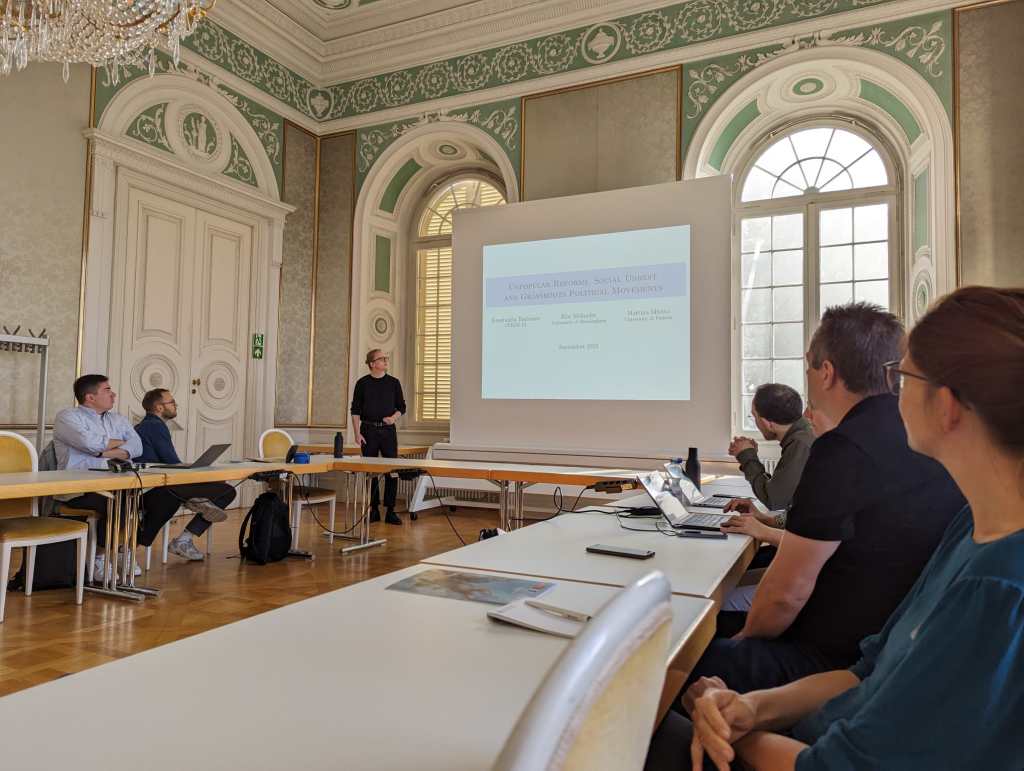
EHES 2025 in Hohenheim

The EHES 2025 conference at the Universität Hohenheim has come to an end. I want to thank everyone who helped make it possible. Without my team, the many engaged colleagues, helpers, and participants, this would not have been nearly as successful.
For me, it was a truly special moment in my career to host this conference as President of the Society. What made it even more special was the presence of people who have shaped my path in economic history:
Albrecht Ritschl, who first inspired me to enter the field, my PhD supervisor Kevin O’Rourke,
Mary O’Sullivan, who was an important role model for me, and important companions over the past decade, including Jochen Streb, Carsten Burhop, Dr. Fabian Wahl, and PD Dr. Felix Selgert.
This combination of scholarship, community, and personal connections made the conference an unforgettable experience. Thank you to everyone who contributed! Now I hand over the baton to Oscar Gelderblom, who will serve as the next President and host the conference in Antwerp in 2027, an event I look forward to very much.

New survey article on data sources for the German capital market in the 19th and early 20th century

This article provides a comprehensive overview of the most important sources and data available for the German capital market, highlighting their capabilities and limitations. We focus on firm-specific information related to stock corporations and price data for the 19th and early 20th Century. By reviewing examples from existing literature, we illustrate the practical applications of these sources. We also launch a new stock index derived from the daily prices of 39 banks listed on the Berlin Stock Exchange, demonstrating the potential of price data for market analysis. Moreover, in the course of the article, some data sets from my previous research were published at Emporion and linked here.The article is part of a special issue of the German Economic Review on historical data sources. The article can be found here: https://www.degruyter.com/document/doi/10.1515/ger-2024-0067/html

New publication on how inflation impacts saving behaviour

Our microeconomic study of the savings behavior of 2,500 German savers in the second half of the 19th century allows us to explore the causes of individual savings decisions in an emerging economy. Inferring savers’ inflation expectations from the personal inflation experiences they made we confirm the standard interpretation of the Euler equation: The savers of our sample reduced their savings with an increase in this proxy for inflation expectation. Beyond this result, our study provides three additional insights. First, we observe a non-linear relationship between inflation experience and savings, implying that savers responded only to exceptionally high inflation (and deflation) experiences ignoring smaller fluctuations in this measure. Second, we find that savers also reacted to high deflation experiences with reducing their savings. This surprising behavior becomes reasonable when we consider that, in the second half of the 19th century, the globalization-driven decline in consumer prices was associated with an increase in nominal wages. Third, we show that it was mainly long-time female savers with above-average savings balances who adjusted their savings to changing inflation experiences. For more see: Journal of Banking & Finance
Volume 154, September 2023, 106978

New publication on the role of the scientific revolution

We analyze the role of the Scientific Revolution in the takeoff to sustained long-run economic development. Basic scientific knowledge is a necessary input in the production of applied knowledge, which, in turn, fuels productivity growth and leads to rising incomes. Subsequently, rising incomes instigate a fertility transition and foster education investments. Together, the increasing stocks of basic scientific knowledge and human capital, and the concomitant reduction in fertility enable economic development. In regions where scientific inquiry is severely constrained—for example, due to religious reasons or due to oppressive rulers—the takeoff is delayed or may not occur at all. This shows the importance of investing in basic scientific inquiry when trying to achieve long-run economic prosperity. Our framework could contribute to the understanding of why sustained economic development emerged first in Europe and not in technologically more advanced China. Click here for the whole paper.